IdeasFeature
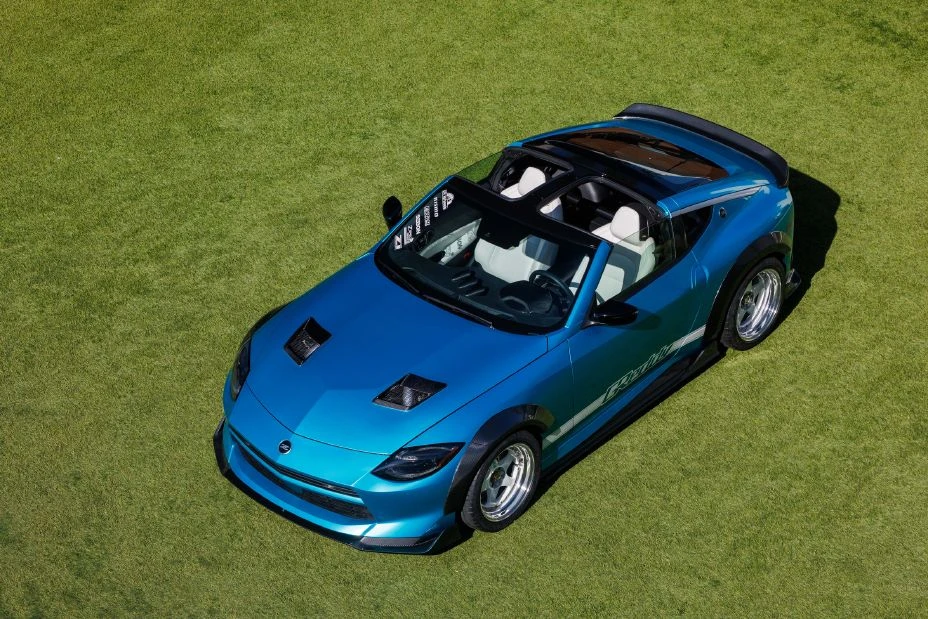
More Sky, Not More Power
Nissan’s Z Kaze concept brings back T-tops and restores a set of NISMO LMGT2s. Its best idea has nothing to do with another horsepower number.
The most telling thing about Nissan’s Z Kaze concept is not under its hood. It is above the occupants’ heads.
At ZCON on 23 September, Nissan showed a Pacific Teal Z with a custom-engineered T-top and restored NISMO LMGT2 wheels: the familiar present-day car made sharper, wider and unmistakably period-specific.
But the roof is the argument. Nissan calls the Kaze a concept vehicle not available for purchase. It is an invitation to imagine, not an order guide.
It is nevertheless an unusually revealing invitation. Nissan says the project was conceived by product planners and designers as a passion project about nostalgia, heritage and driving enjoyment across the Z’s seven generations. The name comes from the Japanese word for wind; the team’s stated mental picture was a summer run on the Pacific Coast Highway. That may sound like department-store mood boarding until one notices what the concept refuses to do. It does not chiefly promise an enormous output number, an extreme lap time or a new transmission. It is making the case for a different sensory upgrade: more sky, more sound, more contact with the place through which the car is moving.
That is a more interesting kind of nostalgia than simply painting an old badge onto a new object. A T-top is not a convertible, and its appeal was never only a geometric compromise. Its panels make the roof something you participate in. You remove them, decide where they live, hear the cabin change, look out through a different frame. There is a little ceremony before the journey can become less sealed. On an ordinary errand, that is absurd. On a good evening, it is the whole point.
The Kaze’s restored 18-inch NISMO LMGT2s make the same argument in a different language. Nissan says they are an authentic, long-out-of-production set restored and rebuilt for the concept. This is not generic performance-wheel shorthand. A recognisable object from the brand’s tuner history sits beside a roof type associated with the Z’s open-air past. The car looks assembled from memory, not filtered through it.
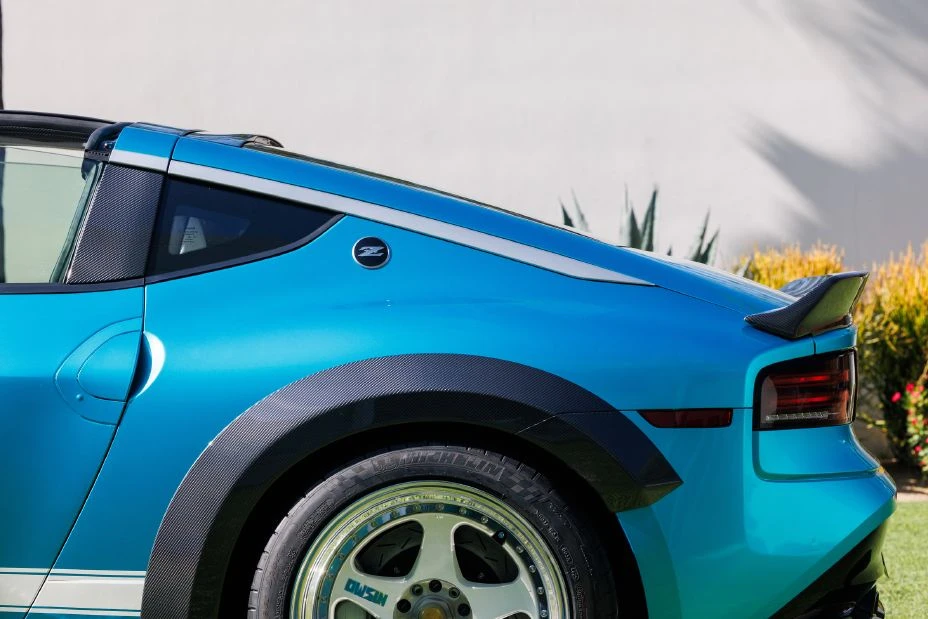
Rear-quarter detail of the Kaze concept. Nissan identifies the restored LMGT2 wheel and carbon-fibre body modifications. Nissan.
There is a risk in celebrating this too quickly. Nostalgia can turn a sports car into a costume: teal paint, carbon weave, a few old names and a crowd asked to applaud its own recollection. Yet the Kaze avoids the worst version of that trap because its central gesture has a consequence. Removing roof panels changes the experience of the cabin. Whether that gesture can be carried through a production program is unresolved; as a concept, it is at least using visual memory to propose a different kind of use.
That distinction matters now because sports cars are routinely discussed as if their worth were an Excel column. More output, less time, one more mode, another composite panel. Those things may be excellent. They are not the only way to improve a drive. An open roof can make a familiar road feel newly available without making the engine more powerful. A wheel that recalls a specific street-and-track culture can tell a richer story than a wheel engineered only to fill an arch. Pleasure is not anti-engineering; it is one of the reasons engineering exists.
The Kaze has enough specificity to avoid being a sketch, but it declines to make a power number its headline. That keeps the emphasis where the project puts it: a change of atmosphere, literally. We do not need to reverse-engineer a dyno chart to understand that a sports car can be better for being less hermetic.
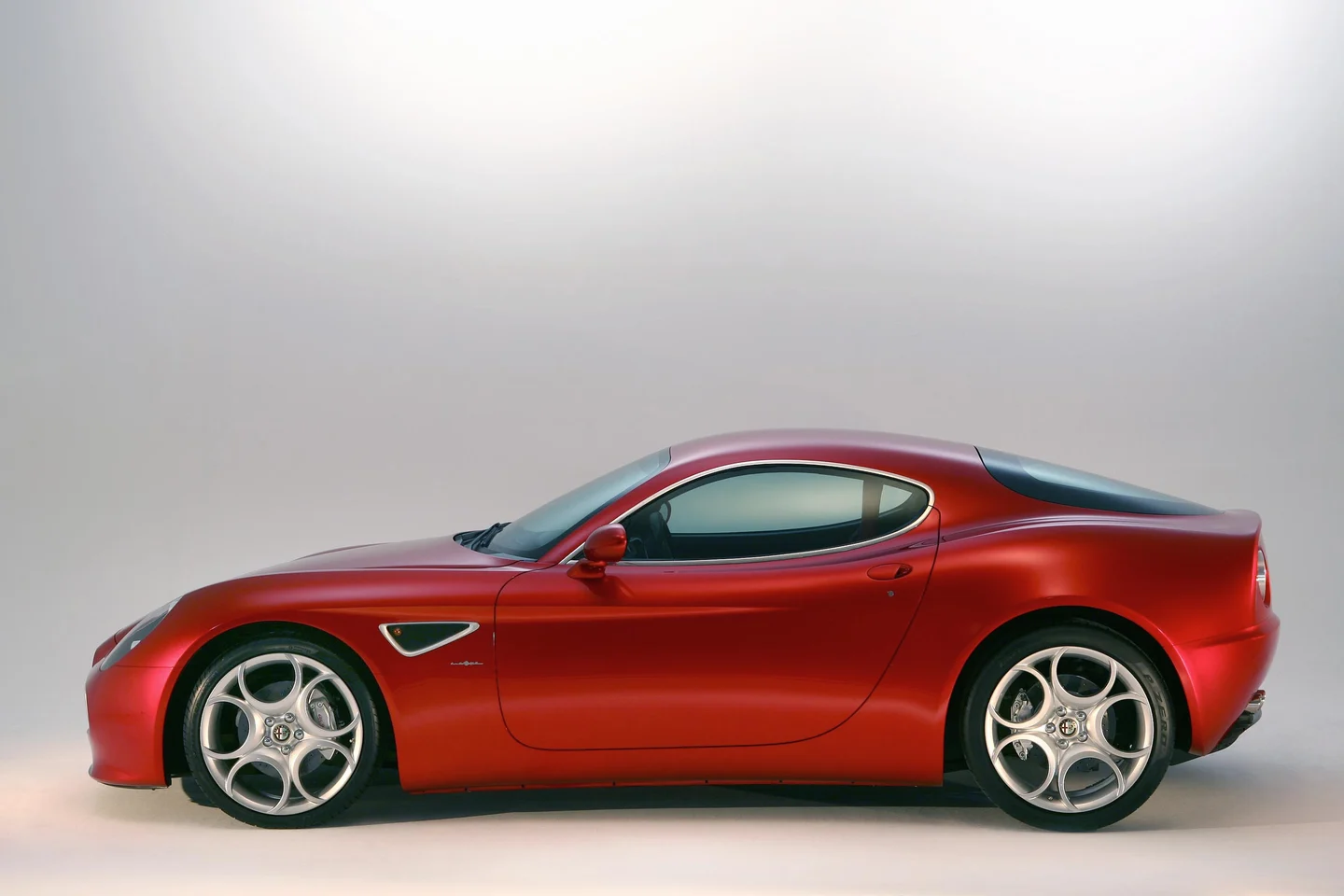
There is a faintly old-fashioned confidence in this. The 8C Competizione was an occasion in part because it did not hide the fact that cars are also made to be looked at and anticipated; the Kaze makes a smaller, more democratic claim. It asks whether a contemporary sports car can afford a feature that exists mainly to make a good road feel more like an event. The answer depends not on sentiment alone but on whether Nissan chooses to do the hard work of making the roof durable, usable and coherent as a production car.
For now, even the optimistic reporting deserves precise language. Ponz Pandikuthira, Nissan Americas’ chief product and planning officer, told The Drive that fan response could make the vehicle happen. That is a conditional invitation, not a production confirmation. The best response is to say plainly why it is worth making: not because another Z needs a louder specification sheet, but because the best sports cars still leave room for weather, sound, ritual and a little unnecessary joy.
Sources
Go deeper
ObjectsFeature
The Occasion
Anticipation and presence are part of a sports car’s purpose.
Read the feature
IdeasFeature
Bentley Already Had the Answer
Two very different approaches to the atmosphere inside a new car.
Read the feature
GarageFeature
Build the Porsche You’ll Actually Use
Making a familiar sports car fit the life you want to give it.
Read the feature