ObjectsFeature
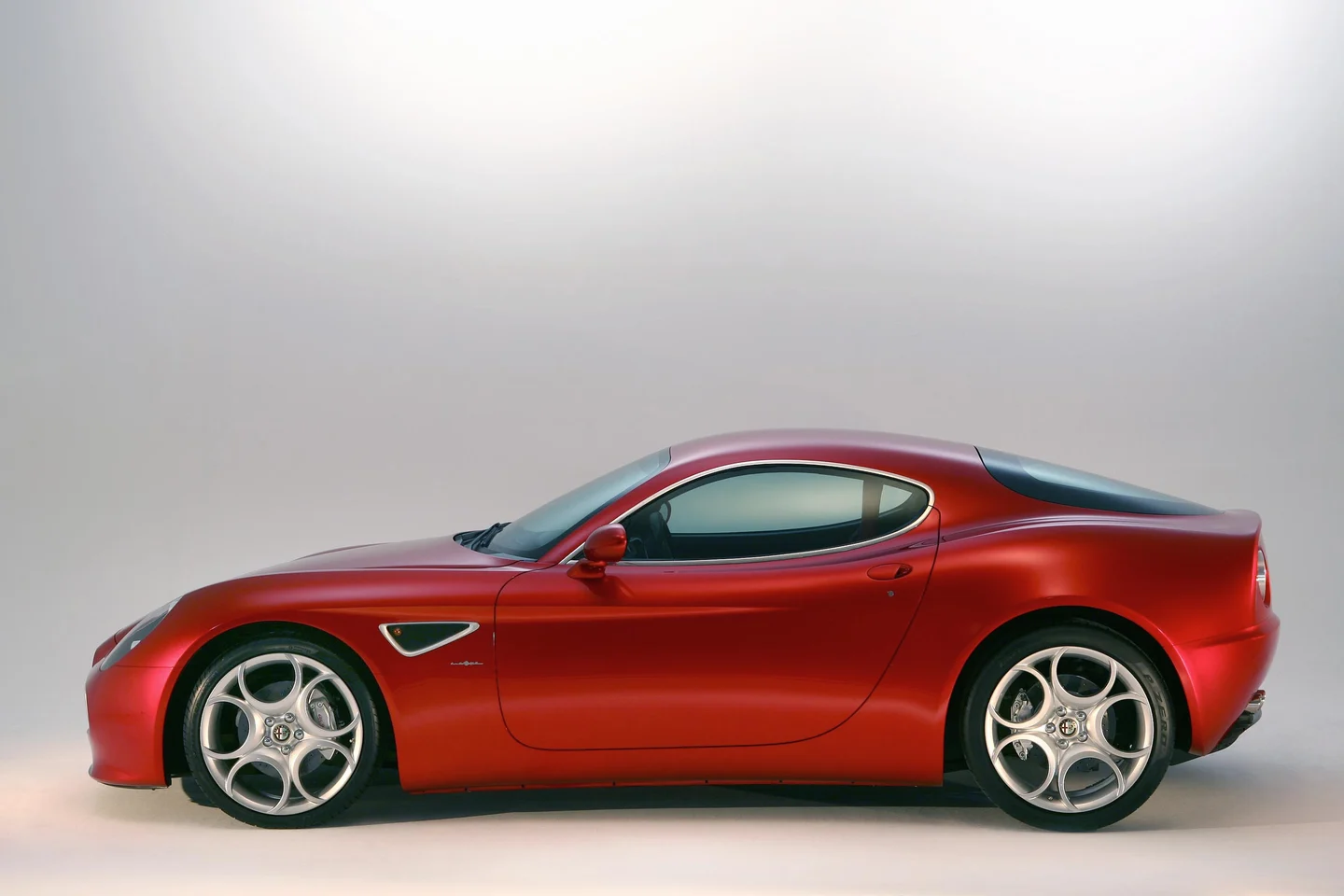
The Occasion
The production 8C’s visual confidence sits over a real transaxle system: a front V8, torque tube, rear gearbox, differential and hydraulic actuator.
The Alfa Romeo 8C Competizione does not need a spreadsheet to announce itself. The shield sits deep between paired horizontal intakes; a long bonnet runs to a compressed cabin; broad rear haunches complete the form rather than interrupt it. The car has drama, but it does not need a forest of vents or sharp creases to make the point. The closer look is rewarded because the body sits over a remarkably deliberate mechanical layout.
Alfa Romeo’s later account places production approval in early 2006, credits Wolfgang Egger’s Centro Stile with the design development, and records the final production car’s Paris presentation later that year. It says the planned 500 cars were sold before production began. The chronology matters. The 2003 8C concept had a supercharged 4.2-litre V8; the production 8C is a different car, with a naturally aspirated 4,691 cc V8 and a rear-mounted six-speed automated sequential gearbox.
01The production car’s structure
Museo Alfa Romeo describes a pressed-steel structure with carbon-fibre body panels and a stated 1,585 kg weight. That distinction is more interesting than calling the whole car “carbon.” The panels make the visible surface; the steel structure carries the basic load-bearing task. Alfa’s retrospective also refers to a dual-frame approach and the use of aluminium, titanium, carbon and composite materials. The construction is layered, rather than a single-material slogan.
The body’s restraint makes that layered construction feel secondary when looking at it, which is probably why the car has held its visual force. The front wings rise around the bonnet without turning into an elaborate graphic. The side is allowed to remain broad. The roofline flows into the rear instead of stopping abruptly above it. The familiar Alfa shield and two horizontal intakes provide just enough historical grammar; the proportions do the rest.
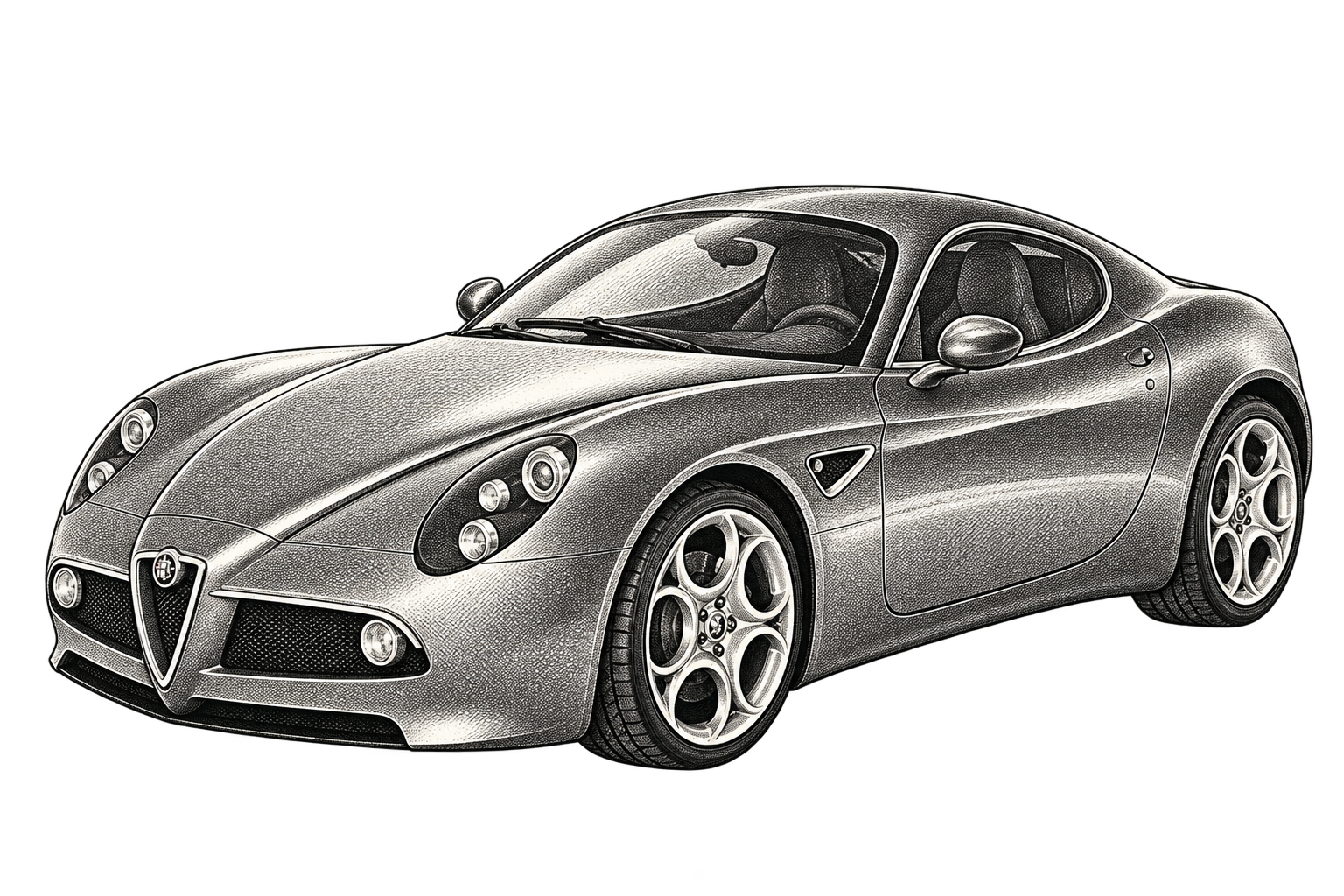
Illustration — Studio Chicane. An exterior visual study, not a technical specification or repair drawing.
02The gearbox is in the sentence
“Rear-mounted six-speed automated sequential gearbox” is more than a catalogue phrase. Alfa’s contemporary technical material describes a transaxle layout: the front-mounted longitudinal engine is connected rigidly to a rear gearbox assembly that incorporates the differential and hydraulic actuator. A tubular member joins the engine and gearbox, with the driveshaft rotating inside it. In other words, the engine and gearbox are separated along the car’s length but tied together as one driveline structure.
That placement has two obvious consequences. It moves the gearbox and differential mass toward the rear axle, and it gives the V8’s output a long, enclosed route to the rear transaxle. Alfa presented the arrangement as a way to balance load between front and rear. The car also used a limited-slip differential within that rear assembly. The layout is not a retro ornament; it is the organising principle behind the phrase “front engine, rear gearbox.”
The sequential transmission itself is a six-speed mechanical gearbox with hydraulic actuation, not a torque-converter automatic. Alfa says ratios can be selected with paddles behind the steering wheel, and describes Manual-Normal, Manual-Sport, Automatic-Normal, Automatic-Sport and Wet modes. Those are useful facts because they explain the interface. The paddles request a gear; the hydraulic actuator performs the clutch and gear-selection work. The mode names describe the control strategy Alfa offered around that hardware.
03Form and layout together
This gives the 8C’s proportions a mechanical companion without trying to claim that a material choice “caused” a particular curve. The long bonnet and rearward gearbox have a shared longitudinal logic. The cabin is compact because the car’s mass and functions are spread deliberately at either end. That is not a secret hidden beneath the styling; it is part of the production car Alfa chose to build.
The planned run of 500 and the statement that it sold before production began can make the 8C seem pre-validated by scarcity. Scarcity is not its best argument. The better one is concentration. Alfa committed a steel structure, carbon-fibre panels, a 4.7-litre V8 and an elaborate rear transaxle to a coupe whose surfaces stay calm enough to let its proportions speak.
The 8C is an occasion because the technical sentence and the visual sentence arrive together. Read the grille, intakes, bonnet and haunches first. Then read the torque tube, rear gearbox, differential and hydraulic actuator beneath them. Neither needs to be turned into mythology for the car to feel unusually complete.
Sources
Go deeper

IdeasNote
The Brochure Promised a Life
Another way to read a car's visual appeal, this time through the worlds a manufacturer builds around it.
Read the note
GarageFeature
The Parts Promise
After the beauty comes the long-term question: how does a manufacturer support an unusual low-volume car?
Read the feature