GarageNote25 September 2026
The Shape, the Specification
The US-market 2016 G550 paired a 4.0-litre biturbo V8 with rigid axles, a two-speed transfer case and three locking differentials. Its old silhouette hides a very specific mechanical brief.
A G-Class can look so familiar that its specification disappears behind its outline. Upright glass, square body panels and an exposed rear spare invite instant conclusions about what it is. The 2016 US G550 deserves the slower reading. Mercedes-Benz USA paired a 4.0-litre biturbo direct-injection V8, rated at 416 hp and 450 lb-ft, with a seven-speed automatic, permanent four-wheel drive, rigid front and rear axles, a two-speed transfer case, and locking centre, rear and front differentials.
That is not a generic “old-school G-Wagen.” It is a particular mechanical package from a particular model year: contemporary forced induction and automatic shifting meeting a four-wheel-drive architecture whose individual parts can be named.
01Why three locks matter
A differential allows wheels on the same axle to turn at different speeds. That is essential in a bend because the outside wheel travels farther than the inside one. Mercedes-Benz’s 2016 operator’s manual explains the trade: a differential can send drive toward the wheel with least grip because that path offers least resistance. The G’s 4ETS system counters this in ordinary traction work by braking a spinning wheel and directing more drive to the wheel with grip.
The vehicle has three mechanical locking differentials: the transfer-case centre lock, a rear-axle lock and a front-axle lock. Locking the transfer-case differential makes front and rear wheels rotate at the same speed. The manual describes the locks as the additional measure for more challenging conditions and notes that, when locks are engaged, ABS, 4ETS, ESP and BAS are deactivated. That last detail is the useful one: locking a differential is not a decorative dashboard ritual or a universal traction mode. It changes the relationship between the drivetrain and the electronic systems.
The two-speed transfer case provides the other half of the language. “Low Range” is a lower gearing range in the transfer case, intended to multiply the engine’s torque at the wheels at lower vehicle speeds. It is not a second engine personality and it does not make surface, tyres, clearance, judgement or vehicle condition irrelevant. It is a gear reduction built into the driveline.
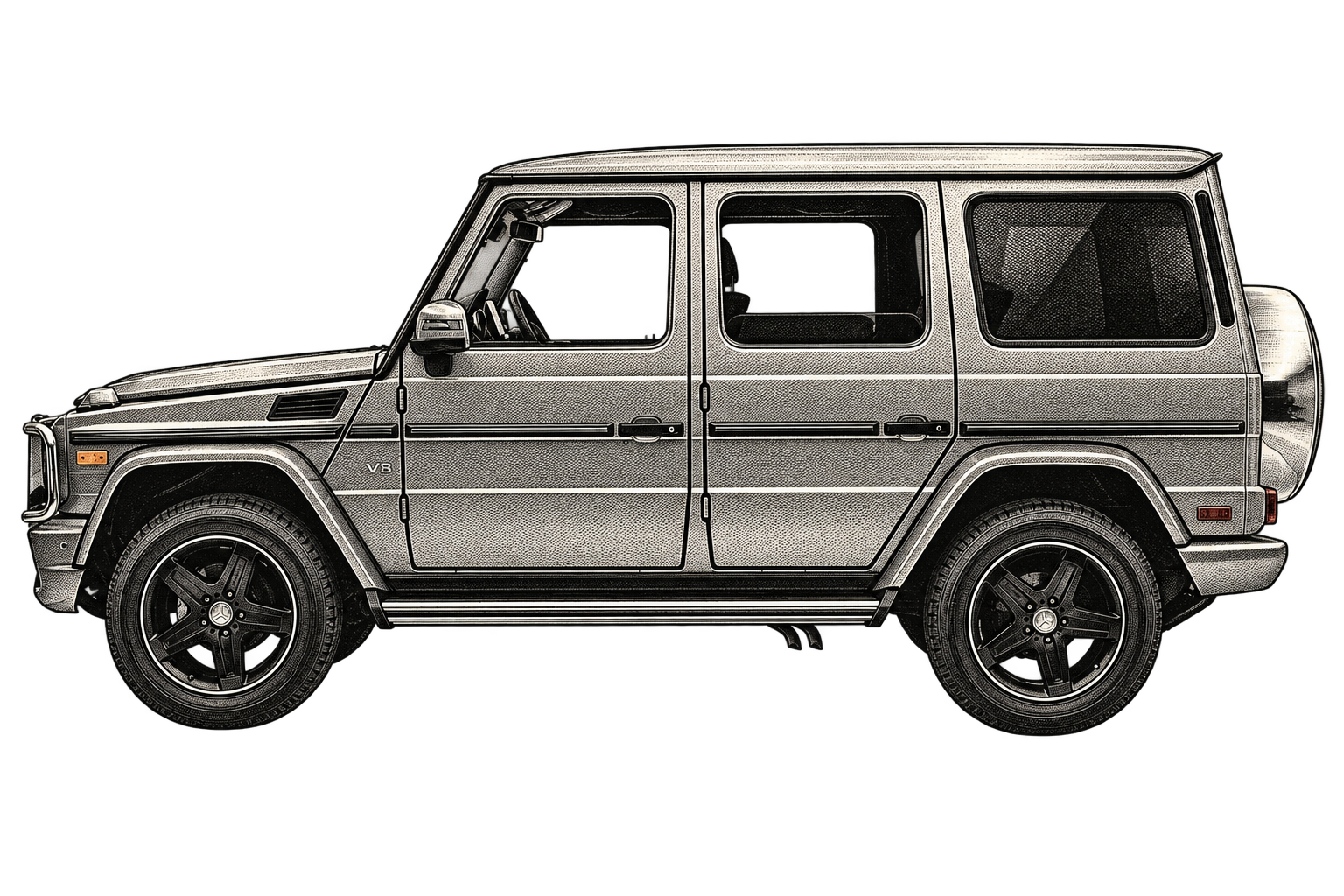
Illustration — Studio Chicane. An exterior visual study, not a technical specification or repair drawing.
02Rigid axles and a modern V8
Rigid front and rear axles are equally easy to romanticise. The simple engineering fact is that each axle links its two wheels structurally; it is not the independently moving arrangement used by many modern road vehicles. In the G550, that arrangement sits alongside permanent four-wheel drive, the transfer case and the three locks. It explains why the brochure’s specification reads more like a named drivetrain system than a set of lifestyle adjectives.
Above it is the 4.0-litre biturbo V8 and seven-speed automatic. The contrast is the car’s subject. The G550 did not preserve an earlier hardware arrangement by refusing contemporary powertrain engineering. It combined rigid axles and lockable differentials with direct injection, turbocharging and a seven-speed automatic. That is a more interesting tension than the blunt question of whether the G-Class is a tool or a fashion object.
Mercedes’s brochure exploits the tension visually. One spread is almost monochrome: grey sky, rocky terrain, a deep green G and a narrow gold strip. Another puts warm brown diamond-quilted upholstery against a black cabin and a city view. The imagery moves from geological scale to luxury interior without changing the vehicle. It sells permission to inhabit two incompatible-looking worlds. The drivetrain gives the claim mechanical vocabulary; the photography gives it theatre.
03Read the exact year
The G550 does not need the G63 or G65’s engine stories to be substantial. Its own V8, seven-speed automatic, rigid axles, two-speed transfer case and sequentially arranged locks are enough. Those details also prevent the silhouette from becoming a historical blur.
A familiar outline does not make a car generic. In the 2016 G550 it makes specification-reading necessary: first the three differentials and the transfer case, then the axle arrangement, then the biturbo V8, and finally the body that makes all of it easy to overlook.
Sources
Go deeper

IdeasNote
The Brochure Promised a Life
See how the same 2016 catalogue used landscape and interior photography to sell the G-Class's appeal.
Read the note
ObjectsExplainer
The Name on the Engine
A separately scoped account of AMG assembly explains why the nameplate alone cannot stand in for a manufacturing history.
Read the explainer