GarageExplainer25 September 2026
The American Argument
Nearly half of BMW's US E36 M3 sedans left the factory with an automatic. That is an interesting car—and audience—to take seriously.
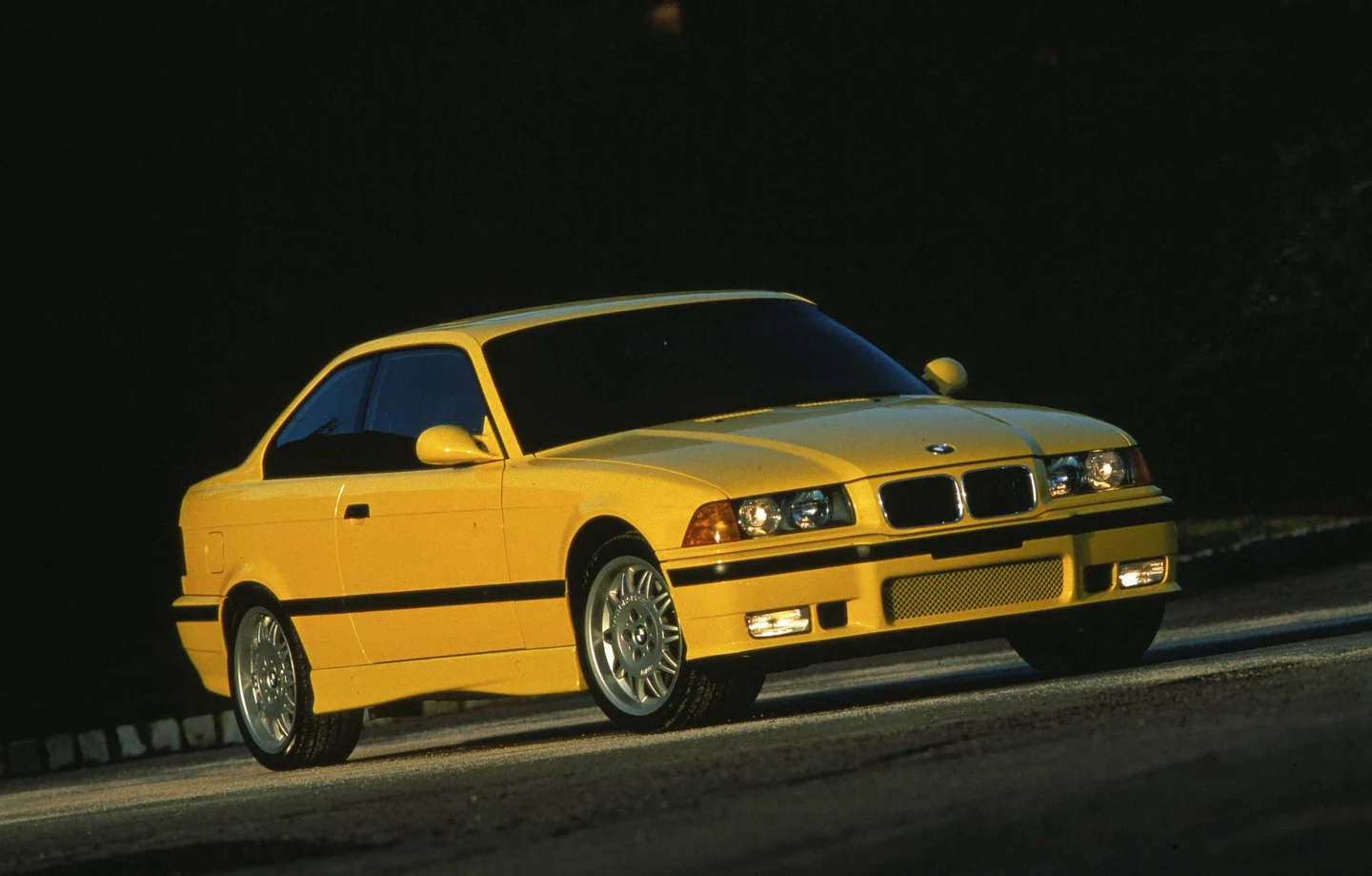
The North American E36 M3 is often introduced by subtraction. Start with a European M3, remove whatever an argument needs removing, and call the result a compromise. That approach has the useful property of being quick. It also makes a muddle of years, body styles, engines, markets, and transmissions. BMW Group Classic’s own record for the US-market sedan suggests a more rewarding question: what did BMW actually build for the people who bought this version?
For 1996–98, BMW identifies the US M3 sedan as the S52B32 US model. Its published displacement is 3,152 cc and its output is 178 kW at 6,000 rpm. BMW describes the engine as based on the contemporary E36 M52. Those are modest but consequential facts. They tell us this was a specific US-market sedan with a stated engine relationship, not a European coupe accidentally fitted with rear doors.
01Stop comparing unlike cars
The word “detuned” persists because it seems to make the whole subject efficient. It may describe a difference in a loose conversational sense, but it is a poor substitute for identifying the two cars being compared. An early European 3.0-litre coupe and a later US 3.2-litre sedan are not a neat before-and-after experiment. They differ in market, period, body, and engine context. A numerical gap lifted from their brochures cannot prove which has better midrange response, greater durability, more appeal on a road, or a superior reason to exist.
BMW’s model pages are useful precisely because they keep their subjects separate. The company’s Classic material distinguishes the two E36 coupe versions from the US sedan entry. That does not erase regional differences, and it does not require anybody to prefer the sedan. It does set a basic editorial standard: name the version before turning it into a verdict. The S52B32 US description is an anchor for a US-sedan story; it should not be stretched into a universal account of every E36 M3.
There is a larger point here about technical language. “Based on” is neither an insult nor a romantic compliment. It is a defined statement of engine-family relationship from BMW’s own account. It offers a better starting place than both extremes: the claim that the US car is secretly identical to a European counterpart, and the claim that it is not worth examining because an output figure differs. A model can have distinct engineering and still deserve a close reading.
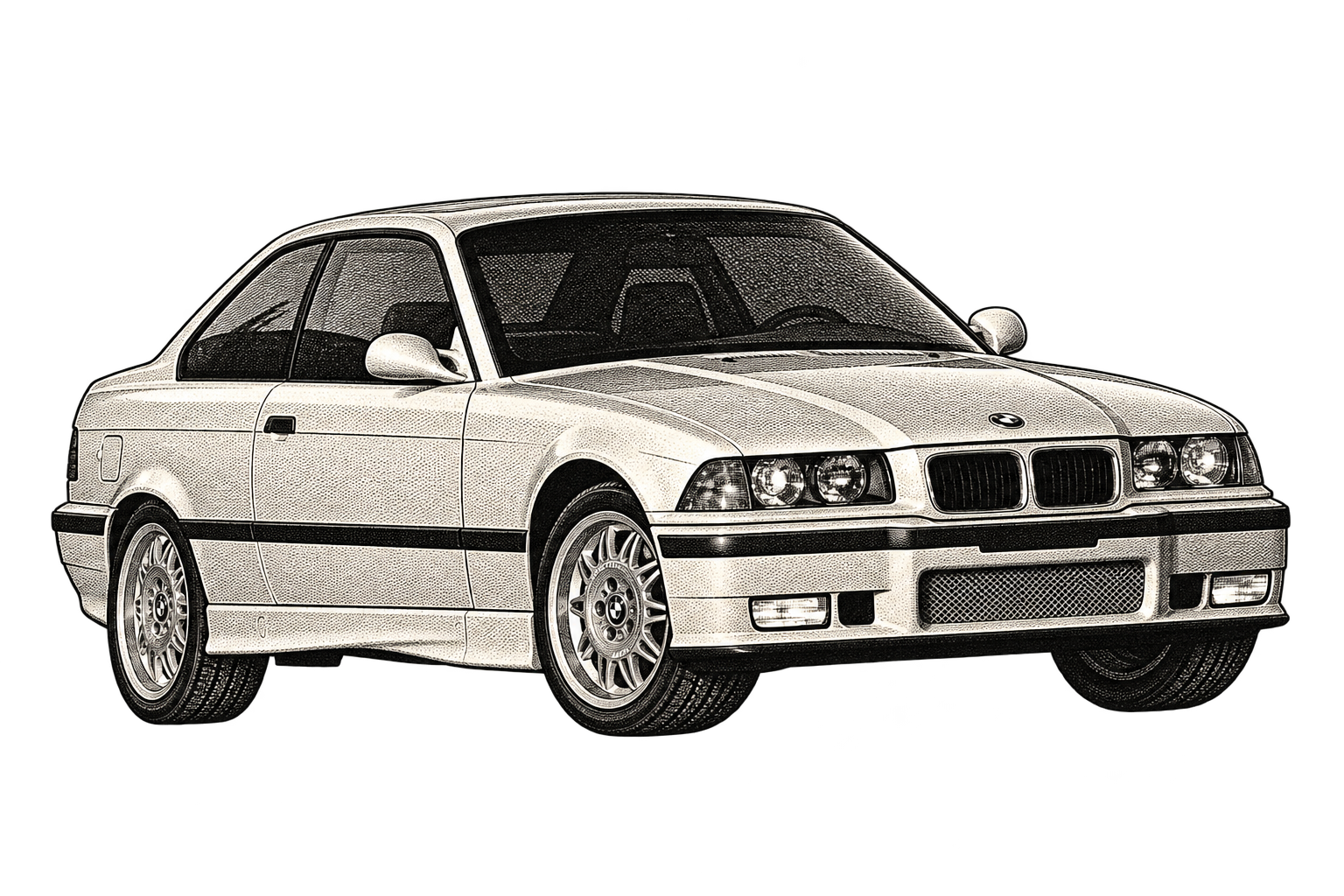
Illustration — Studio Chicane. An exterior visual study, not a technical specification or repair drawing. The illustrated coupe differs from the US sedan specification discussed here.
02The transmission statistic is a social fact
The most revealing number in BMW’s US-sedan record may not be its output. BMW records 8,610 US M3 sedans and says around 47 per cent were factory-fitted with an automatic transmission. The arithmetic matters: 47 per cent is not a majority. Manuals remained the larger share, but only narrowly. That makes the sedan’s audience more complex than the simplified enthusiast image of an M3 as a single-purpose manual object.
A factory automatic take rate does not prove why every purchaser chose one. It cannot tell us about traffic, family use, dealer stock, preference, or the subsequent lives of individual cars. It does, however, establish that the automatic was not an invisible fringe within this documented sedan population. Nearly half is too large a share to treat as an embarrassment added later by somebody else. BMW offered the choice, and the recorded buyers chose it in substantial numbers.
That changes the way the sedan can be discussed. The automatic is not required to be a secret enthusiast favourite to be historically meaningful. The manual does not become less appealing because it was the narrow majority. Both statements can be true at once: a reader may seek a manual car, and the record may require an account of the automatic cars as part of the model’s real audience.
03A car with its own brief
The US sedan’s case is not that it reproduces an earlier European coupe in a different body. Nor is it that every difference is irrelevant. Its case is that BMW made a later US-market M3 sedan with a named engine configuration and a near-even transmission split. That is enough to shift the emphasis from loss to purpose.
It is also a reminder that a production statistic is not a substitute for an individual inspection. VIN, maintenance records, modifications, condition, and equipment all still matter if the subject is a particular car. The Classic page cannot tell a future owner which example is healthy or satisfying. It can stop the conversation from beginning with a caricature.
The American argument is therefore not a plea for forced equivalence. It is an argument for accuracy and attention. The US E36 M3 sedan should be read as the car BMW documented: S52B32 US, 3,152 cc, 178 kW at 6,000 rpm, 8,610 recorded sedans, and roughly 47 per cent automatic. A manual may be the version someone wants. It need not be the only version worth understanding.
Sources
Go deeper
GarageFeature
The E39 540i Six-Speed, on Its Own Terms
A different BMW whose manual and automatic versions were part of a specific factory equipment strategy.
Read the feature
GarageExplainer
The S54: The Last of the Great Bavarian Hearts
Read the original S54 essay alongside the earlier American M3, keeping the different engines and eras distinct.
Read the explainer